


15th Massachusetts Volunteer Infantry

Forged in Worcester County: The Founding of a Regiment

A Nation Mobilizes: The Spring and Summer of 1861
When Confederate batteries opened fire on Fort Sumter at 4:30 a.m. on April 12, 1861, the United States possessed a standing army of roughly 16,000 soldiers spread across a continent. President Abraham Lincoln faced an immediate crisis, compounded by a stubborn legal constraint: the Militia Act of 1795 limited any presidential call for state militiamen to a maximum of ninety days of service. On April 15, Lincoln issued a formal proclamation summoning 75,000 militia volunteers from the loyal states, expecting a swift and overwhelming show of force to end the rebellion before it took root.
That calculation would prove disastrously optimistic. In the weeks between Lincoln's April call and the formal organization of new three-year regiments, both sides spent their time rapidly mobilizing, drilling raw volunteers, and maneuvering for position. No major pitched battles punctuated the spring of 1861, but the underlying realities of the conflict were already becoming clear to anyone who looked honestly at the geography and determination of the Confederate states.
On May 3, 1861, Lincoln issued Proclamation 83, formally titled Proclamation Calling Militia and Convening Congress. This pivotal follow-up to the April 15 call authorized the enlistment of 42,000 volunteers for three years of service, expanded the Regular Army by more than 22,000 officers and men, and directed the recruitment of 18,000 additional seamen for the Navy. Crucially, it also convened Congress to an extraordinary summer session beginning July 4, 1861, to formally appropriate funding and legal authority for the enlarged war effort. There was a significant constitutional wrinkle, however: only Congress held the power to formally raise armies, and Congress was not yet in session. The May 3 proclamation represented a presidential commitment, but the legal structure to underwrite three-year enlistments would not exist until Congress acted.
The disaster that made the timeline undeniable came on July 21, 1861, when poorly trained Union and Confederate forces clashed at the First Battle of Bull Run near Manassas, Virginia. The Union army was routed, and civilian spectators who had gathered to witness what many expected to be a quick, decisive Federal victory fled in panic alongside retreating soldiers. Congress convened on July 4 as called, and the day after Bull Run it passed legislation authorizing the President to raise up to 500,000 volunteers, extending the standard term of enlistment from ninety days to three years. The short-war fantasy was finished.
The men gathering that summer at an agricultural fairground in Worcester already knew it.
The Worcester County Regiment: Organization at Camp Scott
Long before Congress acted, the men who would form the 15th Massachusetts had already read the situation correctly. The regiment was composed almost entirely of men from Worcester County, central Massachusetts towns with deep militia traditions and, in many cases, veterans of the Mexican-American War (1846 to 1848) or families rooted in the multi-year campaigns of the American Revolution. Their officers and senior non-commissioned officers understood that a conflict spanning a massive geographic territory against a determined foe could not be suppressed in three months. While the Northern press called for a quick march on Richmond, the men of Worcester County were committing to three years.

The key to understanding the regiment's founding lies in a precise legal distinction. In May and June of 1861, companies across Worcester County began forming, drilling, and taking oaths for three years of service under the Commonwealth's own authority, independent of the still-incomplete federal framework. By June 12, 1861, those companies had begun gathering at Camp Scott, a training camp established at the agricultural fairgrounds in Worcester and named for Major General Winfield Scott, commander of the U.S. Army. The regiment was preliminarily organized on June 28, 1861, and formally mustered into federal service on July 12, 1861, ten days before Congress convened after Bull Run and officially codified the legal basis for three-year volunteer regiments. In that narrow window, the 15th Massachusetts stood as a regiment organized under state authority for a three-year term before the federal structure had caught up with the commitment its men had already made.

This was not a collection of raw, unorganized civilians improvising at a fairground. The regiment was built deliberately from the backbone of pre-existing, disciplined state militia units with established leadership structures, training regimens, and equipment. Lieutenant Colonel George H. Ward had commanded the Worcester City Guards for more than a decade before the war. Major John W. Kimball had been a leading officer of the Fitchburg Fusiliers. The institutional memory these men brought to Camp Scott was not incidental to the regiment's formation; it was its foundation.
After completing their organization at Camp Scott, the regiment departed Worcester for Washington, D.C., on August 8, 1861.
Ten Companies from the Heart of Central Massachusetts
The 15th Massachusetts was organized into ten companies, designated A through K, each raised from a specific city or town across Worcester County. Several companies carried the names of pre-existing militia units that had simply converted their structure into the federal volunteer framework. While each company had a designated hometown where its nucleus was recruited, men from surrounding communities also joined these companies to fill out their required rosters; towns such as Winchendon, Westminster, Lancaster, and Upton contributed men to various companies across the regiment.

Regimental Leadership: Field and Staff Officers
The original regimental leadership brought together some of the most capable men in Worcester County, several of whom would go on to careers of national significance. The table below identifies the original field and staff officers, their subsequent promotions, and their later histories.
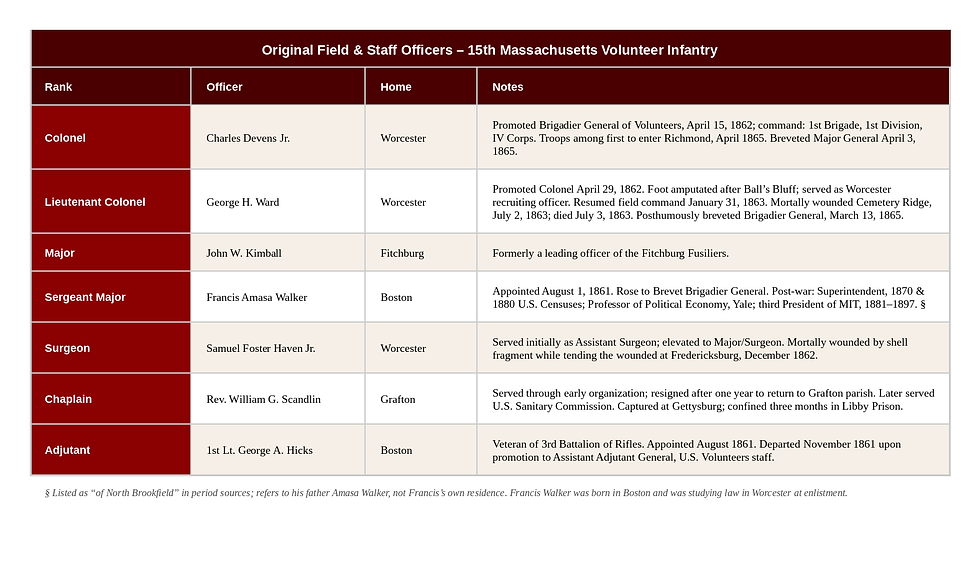
Colonel Charles Devens deserves particular attention. Born in Charlestown in 1820, Devens had built a distinguished pre-war career as a lawyer, Massachusetts State Senator, and United States Marshal before commanding the regiment. He delivered a rousing public address at Mechanics Hall in Worcester on April 16, 1861, calling on the city's young men to join him. Wounded at the Battle of Ball's Bluff in October 1861, he was promoted to Brigadier General in April 1862 and went on to command brigades and divisions through the end of the war, his troops among the first to enter Richmond in April 1865. After the war, he served as Associate Justice of the Massachusetts Supreme Judicial Court and as the 35th Attorney General of the United States under President Rutherford B. Hayes. An equestrian statue of Devens stands in front of the former Worcester Courthouse, and Fort Devens, established in 1917 in north-central Massachusetts, was named in his honor.
Three Years of War: Service, Sacrifice, and the Road to Petersburg
From its arrival along the Potomac in August 1861, the 15th Massachusetts was immediately committed to active service. The regiment became part of the Corps of Observation, stationed at Poolesville, Maryland, and played a central role in the disastrous Battle of Ball's Bluff on October 21, 1861, where a large number of the regiment was taken prisoner following a rout on the steep banks of the Potomac. It was the regiment's first major engagement and an early measure of the grinding war they had signed on to fight.
Understanding the regiment's total enrollment requires accounting for three distinct waves of manpower. The original 1,004 officers and men who mustered at Camp Scott in July 1861 formed the regimental core. The devastation at Ball's Bluff triggered the first replacement wave: while Lieutenant Colonel Ward was recovering from his amputation at home in Worcester, he was tasked with filling the depleted companies. An official appeal issued to Worcester County in December 1861 called for thirty-five men per company, and through Ward's recruiting efforts, approximately 300 to 350 fresh volunteers reached the front lines by spring and summer of 1862, in time for the Peninsula Campaign and Antietam. The third wave, arriving in late 1863 and into 1864 following the catastrophic losses at Antietam and Gettysburg, was a markedly different cohort: a mix of conscripts, drafted men, and bounty soldiers. Colonel William F. Fox's regimental tallies note that a notable portion of these late-war replacements deserted or never physically reported to active duty. The combined total across all three waves was approximately 1,720 enrolled men over the regiment's three-year service life.
The regiment went on to serve in the Peninsula Campaign, the Battle of Antietam, Fredericksburg, Chancellorsville, Gettysburg, the Overland Campaign, and finally the Siege of Petersburg. By the summer of 1863, the regiment had suffered losses that would have reduced many organizations to non-existence. At Gettysburg on July 2, 1863, the 15th Massachusetts was heavily engaged on Cemetery Ridge as part of the 1st Brigade, 2nd Division, II Corps, defending the Union left-center against Brigadier General Ambrose Wright's Confederate assault. The regiment entered the field with 239 officers and enlisted men. Although engaged for only about 45 minutes over the course of the three-day battle, it lost 38 men killed or mortally wounded and another 100 wounded, a total loss of sixty percent. Private Roland E. Bowen of Company B, later captured on July 2 and writing from Libby Prison, estimated the regiment had gone into the fight with 182 rifles, with Company B alone losing 11 of its 18 men to capture.

The sixty percent figure is confirmed by editor Gregory A. Coco in his annotations to Bowen's published letters and is consistent with the Union casualty tables in the Official Records (Series 1, Volume 27). A note on the comparative record: Andrew Elmer Ford's 1898 regimental history claimed this represented the highest casualty rate of any Massachusetts unit at Gettysburg, but that claim does not hold up against modern cross-referenced data. The 13th Massachusetts suffered a 65% loss rate on July 1, a fact corroborated by subsequent comparative histories of the battle.
Colonel George H. Ward did not survive Gettysburg. Mortally wounded on July 2 while his regiment fought to hold Cemetery Ridge, Ward died the following morning in a Union field hospital. He had lost his left foot to a cannonball at Ball's Bluff in 1861, returned to command the regiment after a long convalescence, and was struck down at the war's most pivotal battle. His veterans erected a personal monument to him on the battlefield, still standing near the Codori farm on the Emmitsburg Road. It reads: "Here fell mortally wounded July 2d 1863 George H. Ward, Colonel commanding 15th Regt. Mass. Vols."
By June 1864, due to combat losses and disease, the entire pool of more than 1,700 enrolled men had dwindled to just 75 active officers and men on the front lines during the Siege of Petersburg. During the war, the 15th Massachusetts sustained the tenth-highest number of men killed or fatally wounded in action among all 1,200 Federal regiments.
"Their skepticism of the war's duration was tragically vindicated. The regiment went on to fight in nearly every major battle of the Eastern Theater, sustaining the tenth-highest fatality rate of any Union regiment in the entire war."
The End of Service: Petersburg and the Return to Worcester
The regiment's three-year service term ran through the summer of 1864. Before it expired, the 15th Massachusetts suffered one final catastrophe. On June 22, 1864, during the Union offensive at the Siege of Petersburg in the action known as the Battle of Jerusalem Plank Road, Confederate Major General William Mahone launched a devastating flank attack from a concealed ravine against the Union II Corps. The blow fell squarely on the regiment's position, and nearly the entire active fighting strength of the 15th Massachusetts was captured. Only a handful of officers and men escaped.
The survivors were ordered to leave the Virginia front on July 12, 1864. The remnant of the regiment arrived back in Worcester on July 21, 1864, stepping off the platform at Foster Street Station, the city's central rail hub since 1835. The regiment that had boarded trains for Washington in August 1861 with more than 1,000 men had returned with fewer than 90. On July 28, 1864, the survivors were officially mustered out of federal service, and the 15th Massachusetts Volunteer Infantry ceased to exist as an active organization.
Legacy
The 15th Massachusetts Volunteer Infantry's service record reflects both the best of the early volunteer spirit and the full cost of the war's duration. The men who gathered at Camp Scott in June 1861, many of them experienced militia members who had correctly anticipated a long war, did not see the national legal framework catch up with their commitment until after they had already sworn their oaths. Three years later, they had fought the regiment almost to extinction.
The unit's legacy endures in Worcester County through memorials, institutional names, and the stories of its officers. Fort Devens, the Massachusetts Institute of Technology's Walker Memorial Hall, and the monument on Cemetery Ridge at Gettysburg all carry the memory of men who mustered at an agricultural fairground in Worcester County and committed themselves to a war that most of their countrymen were still hoping would be short.
The Living History: 15th Massachusetts Volunteer Infantry in New England
The 15th Massachusetts Volunteer Infantry, Co. A, reenactors are a member unit of the New England Brigade, the premier Union Civil War reenacting organization in New England. With more than 20 member units totaling over 400 reenactors and historians, the New England Brigade represents the soldiers, sailors, and civilians of the Civil War era across the full breadth of the conflict. The Brigade's mission extends beyond battlefield displays; its living history program immerses participants and spectators alike in Civil War era camp life, military drill, period material culture, and first-person impressions, bringing to life the sights, sounds, and textures of a world that no book or film can fully convey. For more than twenty-five years, the men and women of this company have gathered as a family of living historians dedicated to honoring the memory of the men who served in Worcester County's regiment.

Galvanizing: Company B, 4th Alabama Infantry
The unit operates as a galvanizing company, one that portrays both sides of the conflict as events dictate. In addition to its Union portrayal as the 15th Massachusetts Volunteer Infantry within the New England Brigade, the unit portrays Company B of the 4th Alabama Infantry Regiment for Confederate-side events, operating in that capacity as a member company of the Liberty Greys, a regiment-sized living history organization based in New England and organized as the 6th Regiment, 1st Division, Army of Northern Virginia. The Liberty Greys' ten-member companies muster together as a regiment at national events while each company maintains its own individual historical identity. The membership of the two personas is identical: it is one 501(c)(3) organization with two historical identities, holding active membership in both parent organizations.
The 4th Alabama was among the first Confederate regiments organized for the war, forming in May 1861 at Montgomery, Alabama, and mustering into Confederate service under Colonel Egbert Jones. The regiment served with distinction throughout the Eastern Theater as part of the Army of Northern Virginia, fighting at First Bull Run, the Peninsula Campaign, Antietam, Gettysburg, the Wilderness, Spotsylvania, and Cold Harbor before surrendering at Appomattox Court House in April 1865. Company B of the 4th Alabama was originally known as the Tuskegee Zouaves and was recruited from Macon County, Alabama. You can read more about the Historic 4th Alabama and the reenacting portrayal here: https://www.libertygrays.com/post/4thalabamainfantryregiment
The historical connection between the two portrayals runs deeper than geography. The 4th Alabama and the 15th Massachusetts faced each other across several of the same fields, most notably at Antietam and Gettysburg, making the dual portrayal both historically coherent and practically useful. Whether drilling in Union blue or Confederate gray, the members bring the same depth of research and seriousness of purpose to their impression and presentation.
A Mainstream Organization with Range
The 15th Massachusetts is best characterized as a mainstream reenacting organization, one that grounds its impression in authenticity and historical accuracy while remaining broadly accessible and welcoming to new members and families. The unit maintains rigorous standards for drill, camp life, and period-appropriate equipment and clothing, while ensuring that participation is practical and sustainable for members from diverse backgrounds.
Several unit members also participate individually in progressive and campaigner-style events, events that demand a higher degree of material authenticity and a more immersive approach to the soldiering experience. The unit supports and encourages this, recognizing that different events call for different levels of presentation and that individual members' pursuits enrich the company's collective knowledge and depth.
Who We Are
The unit draws its membership from across New England, including Massachusetts, New Hampshire, Connecticut, and Rhode Island, and fields infantry, sharpshooters, field musicians, a chaplain, and Corbin's Battery, a Civil War mountain howitzer crew operating an 1861-model mountain howitzer.
Corbin's Battery takes its name from First Lieutenant Frank S. Corbin of Company I, 15th Massachusetts Volunteer Infantry, credited to the quota of Dudley, Worcester County. Corbin was commissioned as a 2nd Lieutenant in April 1861 at the age of twenty, promoted to 1st Lieutenant on May 21, 1862, and killed in action at the Battle of Antietam on September 17, 1862. He is buried at Corbin Cemetery on Corbin Road in Dudley, Massachusetts, where his family name remains attached to the land to this day. By combining the local artillery tradition with the memory of a Worcester County soldier who gave his life at one of the war's bloodiest engagements, Corbin's Battery connects the living history program directly to the human story of the regiment it commemorates.
The Liberty Greys participate in major national events at Gettysburg, Pennsylvania; Sharpsburg, Maryland; Cedar Creek, Virginia; Bentonville, North Carolina; and Olustee, Florida, as well as regional living history events and battle reenactments throughout New England. New members are welcome. Visit www.15thMVI.com to learn more.
Selected Sources
Primary Sources
U.S. National Park Service. Civil War Soldiers and Sailors System: 15th Regiment, Massachusetts Infantry. https://www.nps.gov/civilwar/search-battle-units-detail.htm?battleUnitCode=UMA0015RI
U.S. War Department. The War of the Rebellion: A Compilation of the Official Records of the Union and Confederate Armies. Series 1, Vol. 27, Pt. 1 (Gettysburg Campaign). Washington, D.C.: Government Printing Office, 1880-1901. [Union casualty tables for the 15th Massachusetts at Gettysburg.]
U.S. Adjutant General's Office. Official Army Register of the Volunteer Force of the United States Army for the Years 1861-65. Washington, D.C.: Government Printing Office, 1867. [Lists Walter Forehand and Walter Gale chronologically under Company G, p. 137.]
Barnes, Joseph K. (Surgeon General). The Medical and Surgical History of the War of the Rebellion. Washington, D.C.: Government Printing Office, 1870-1888. [Field hospital records cross-referencing the wounded of the 15th Massachusetts.]
Massachusetts Adjutant General. Massachusetts Soldiers, Sailors, and Marines in the Civil War. 8 vols. Norwood, MA: Norwood Press, 1931-1935.
Lincoln, Abraham. Proclamation 80 (April 15, 1861) and Proclamation 83 (May 3, 1861). In A Compilation of the Messages and Papers of the Presidents, ed. James D. Richardson. Washington, D.C.: GPO, 1897.
Secondary Sources
Bowen, James L. Massachusetts in the War 1861-1865. Springfield, MA: Clark W. Bryan, 1888.
Busey, John W., and David G. Martin. Regimental Strengths and Losses at Gettysburg. 4th ed. Hightstown, NJ: Longstreet House, 2005. [Modern synthesis reconciling O.R. records, hospital rosters, and National Archives muster rolls; source for 239 engaged strength.]
Coco, Gregory A., ed. From Ball's Bluff to Gettysburg...and Beyond: The Civil War Letters of Private Roland E. Bowen, 15th Massachusetts Infantry, 1861-1864. Gettysburg, PA: Thomas Publications, 1994. [Confirms June 12, 1861 as gathering date at Camp Scott; editorial note at p. 164 confirms 239 engaged, 60% loss at Gettysburg.]
Ford, Andrew Elmer. The Story of the Fifteenth Regiment Massachusetts Volunteer Infantry in the Civil War, 1861-1864. Clinton, MA: Press of W.J. Coulter, 1898. [Regimental history; primary source for company officers, firsthand accounts, and field reports; note that Ford's claim of highest Massachusetts casualty rate at Gettysburg is superseded by later comparative studies.]
Fox, William F. Regimental Losses in the American Civil War, 1861-1865. Albany, NY: Albany Publishing Co., 1889. [Source for total enrollment figures and ranking of the 15th Massachusetts 10th in battle deaths among all Federal regiments.]
Gottfried, Bradley M. Brigades of Gettysburg: The Union and Confederate Brigades at the Battle of Gettysburg. New York: Da Capo Press, 2002.
Sears, Stephen W. Gettysburg. Boston: Houghton Mifflin, 2003.
Walker, Francis A. History of the Second Army Corps in the Army of the Potomac. New York: Charles Scribner's Sons, 1886.
Local and Genealogical Sources
History of Grafton, Worcester County, Massachusetts. Archive.org digitization. https://archive.org/stream/cu31924028820582/cu31924028820582_djvu.txt [Traces local Grafton enlistments into Company G and confirms the "Forehand" spelling.]
15th Massachusetts Volunteer Infantry Roster and Genealogies. http://www.nextech.de/ma15mvi/ [Source for Ward's promotion date of April 29, 1862.]
Worcester Then: Railroads of Worcester. http://www.worcesterthen.com/RR/ [Documents Foster Street Station as Worcester's central rail junction in 1864.]
The Clio. "Foster Street Depot, Worcester, Massachusetts." https://theclio.com/entry/111649
Online Reference Sources
Antietam on the Web. Officer Profile: Captain Walter Forehand. https://antietam.aotw.org/officers.php?officer_id=5715
Antietam on the Web. Officer Profile: Brigadier General Charles Devens. https://antietam.aotw.org/officers.php?officer_id=28
Find A Grave. "George Hull Ward." https://www.findagrave.com/memorial/8054/george-hull-ward
Wikipedia contributors. "15th Massachusetts Infantry Regiment." https://en.wikipedia.org/wiki/15th_Massachusetts_Infantry_Regiment
Wikipedia contributors. "Charles Devens." https://en.wikipedia.org/wiki/Charles_Devens
Wikipedia contributors. "Francis Amasa Walker." https://en.wikipedia.org/wiki/Francis_Amasa_Walker
Wikipedia contributors. "George Hull Ward." https://en.wikipedia.org/wiki/George_Hull_Ward
Wikipedia contributors. "Battle of Jerusalem Plank Road." https://en.wikipedia.org/wiki/Battle_of_Jerusalem_Plank_Road
Wikipedia contributors. "Union Station (Worcester, Massachusetts)." https://en.wikipedia.org/wiki/Union_Station_(Worcester,_Massachusetts)
Suggested Reading
Two books stand above all others for anyone who wants to go deeper into the history of the 15th Massachusetts.
The Story of the Fifteenth Regiment Massachusetts Volunteer Infantry in the Civil War, 1861-1864
Written by Andrew Elmer Ford and published in 1898, this is the regiment's official history, compiled directly from the diaries, letters, and firsthand accounts of its veterans. Ford was thorough, meticulous, and close to his sources; for company-level detail, officer biographies, and campaign narratives told from inside the regiment, there is no substitute. Reprints are available through online booksellers.
From Ball's Bluff to Gettysburg...and Beyond: The Civil War Letters of Private Roland E. Bowen, 15th Massachusetts Infantry, 1861-1864
Published in 1994 and edited by the late Civil War historian Gregory A. Coco, this is an exceptional primary source. The book is a curated collection of 64 wartime letters written by Private Roland E. Bowen of Company B, covering his service from enlistment in 1861 through his capture at Gettysburg and imprisonment. Bowen was not a headquarters officer writing after-action reports; he was a soldier in the ranks, and his letters carry the texture of the campaign as it was actually experienced. Coco's editorial annotations, contextual footnotes, and regimental data make the collection as useful to historians as it is readable for general audiences.
Because the book was issued by Thomas Publications, a small specialty press, it is not reliably found in general bookstores. Used hardcover copies are typically available through ThriftBooks, AbeBooks, and Amazon.


I received an email regarding this letter from Mark Landry, a local Historian in Westminster, MA regarding the 15th and wanted to share it with everyone.
Hi Tom, great article on the history of the 15th. Very detailed and well written. Many of the boys, 18 to be exact, from Westminster were in the 15th as you already know. We lost three of them during the war. George Benjamin who probably drowned at Ball's Bluff and was never seen afterwards. (by the way, my Ben is named after him). Thomas Scollay enlisted at only 15 and died of disease while on furlough at home. Nelson Bathrick was shot in the left leg at Petersburg necessitating amputation and died of his…